When Is Ptosis, or Droopy Eyelid, a Medical Issue Rather Than Just Aging?
As people age, many observe that their upper eyelid starts to droop. Initially, it appears to be a cosmetic issue—drowsy eyes, hooded lids, or a drowsy look. However, the majority of patients are unaware that ptosis, or drooping eyelids, is not always a result of aging.
It may occasionally indicate a neurological condition, muscle weakness, or even a more serious one.
What is Ptosis?
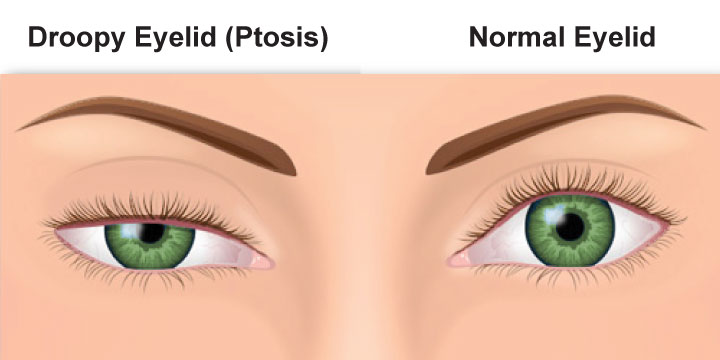
A condition known as ptosis occurs when the upper eyelid descends more than usual.
It may develop later in life or be present from birth, and it can affect one or both eyes.
The eyelid typically rests slightly above the pupil.
Ptosis impairs vision by partially, or occasionally totally, covering the pupil with the eyelid.
Typical Symptoms & Signs:
Ptosis may be present if you observe:
- Eyelid covering part of your eye
- Difficulty keeping eyes open
- Raised eyebrows to see clearly
- Forehead strain or headaches
- Tilting head backward while reading
- Uneven eyes in photos
- Blurred or obstructed upper vision
If left untreated, ptosis in children can result in lazy eye, or amblyopia.
When Ptosis Is Just Aging (Aponeurotic Ptosis):
Age-related muscle wasting is the most frequent cause in adults.
The levator muscle is a lifting muscle located inside your eyelid.
Similar to how skin becomes less elastic with age, its tendon stretches.
Common Characteristics:
- Gradual onset
- Impacts both eyes, frequently in unequal ways.
- Even worse in the evening
- No discomfort
- Not having double vision
Although typically innocuous, this kind can nevertheless impair confidence and vision.
When Ptosis Is a Health Issue ?
Never disregard sudden or unusual drooping.
It might be a sign of a dangerous underlying illness.
1. Nerve disorders, such as neurogenic ptosis
Harm to the nerves that regulate the eyelid.
Potential reasons:
- Third nerve palsy
- A stroke
- Aneurysm in the brain
- Cancers
Warning indicators:
- Abrupt drooping
- Having two eyes
- Issues with eye movement
- A really bad headache
- Pupil dilation
Get an eye exam right away because this is an emergency.
2. Myogenic Ptosis and Other Muscle Disorders
The muscle of the eyelids weakens.
Typical state:
Gravis Myasthenia
Signs and symptoms:
- Ptosis varies throughout the day.
- Even worse at night
- After rest, it gets better.
- Related exhaustion
Patients frequently say:
“In the morning, my eye is normal, but by the evening, it closes.”
3. Ptosis by Mechanical
The eyelid gets heavy because of:
- Eyelid tumors
- Cysts
- Swelling
- Allergies
- Excess skin
4. Children’s Congenital Ptosis
Due to inadequate muscle development, present from birth.
Crucial:
Vision development may be irreversibly impacted if treatment is not received before the ages of 7 or 8.
How Is Ptosis Diagnosed?
For the diagnosis, an ophthalmologist performs:
- Measurement of eyelid height
- Visual examination
- Examination of pupils
- Check for eye movements
- Neurological evaluation
Sometimes tests may include:
- MRI / CT scan
- Blood tests (for Myasthenia)
- Photographs for documentation
- Options for Treatment
The cause determines the course of treatment.
Note: Monitoring may be all that is required for mild age-related ptosis that does not obstruct vision.
Medical Care:
Used in nerve or muscle disorders.
Surgery for Ptosis (Most Common Solution):
A safe, daycare technique that strengthens the muscles used for lifting.
Benefits :
- Enhances vision
- Lessens strain on the forehead
- Restores a youthful appearance
- Eyes that are symmetrical
- Stitches are small and concealed in the crease of the eyelid, and recovery is typically rapid.
When Is the Right Time to See an Eye Specialist?
Consult right away if:
- Sudden eyelid drooping
- Drooping with headache
- Double vision
- Unequal pupils
- Child has droopy eyelid
- Vision blockage while reading/driving
Conclusion:
Not every droopy eyelid is cosmetic. Although the most frequent cause is aging, ptosis can occasionally be the initial symptom of a serious neurological or muscular condition.
- A timely diagnosis can save your life in addition to your vision.
- Do not ignore a drooping eyelid if you or your child notices it.
- A basic eye exam can have a significant impact.
📞 Schedule an appointment with Dr. Svati Bansal for an appropriate assessment and individualized care.